The Days of Holy Week

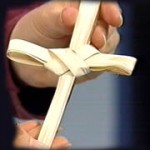 Holy Week is the special week immediately preceding Easter or Resurrection Sunday. It is a time to commemorate the suffering (Passion) and death of Jesus through various observances and services of worship. In Catholic tradition, the conclusion to the week is called the Easter Triduum. The Easter Triduum begins Thursday evening of Holy Week with Eucharist and concludes with evening prayers Easter Sunday.
Palm Sunday (or Passion Sunday)
Holy Week begins with the sixth Sunday in Lent. This Sunday observes the triumphal entry of Jesus into Jerusalem that was marked by the crowds who were in Jerusalem for Passover waving palm branches and proclaiming him as the messianic king. The Gospels tell us that Jesus rode into the city on a donkey, enacting the prophecy of Zechariah 9:9, and in so doing emphasized the humility that was to characterize the Kingdom he proclaimed. The irony of his acceptance as the new Davidic King (Mark 11:10). Sometimes this is accompanied by a processional into the church. In many churches, children are an integral part of this service since they enjoy processions and activity as a part of worship. This provides a good opportunity to involve them in the worship life of the community of Faith.This Sunday is also known as Passion Sunday to commemorate the beginning of Holy Week and Jesus’ final agonizing journey to the cross.
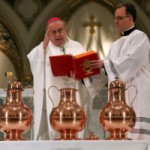 The Chrism Mass or The consecration of Holy Oil
Maundy Thursday is usually the day on which the anointing oil that are used in the Sacraments are consecrated. This is done at a special Chrism Mass.
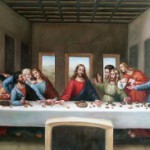 Maundy Thursday or Holy Thursday
There are a variety of events that are clustered on this last day before Jesus was arrested that are commemorated in various ways in services of worship. These include the last meal together called The Last Supper or Passover meal, the institution of the Eucharist or Communion, Jesus washing the disciples’ feet as a sign of servanthood, Jesus praying in Gethsemane and the betrayal by Judas. Most liturgies, however, focus on the meal and communion as a way to commemorate this day.However, the Eucharist of Maundy Thursday is especially connected to the theme of ‘Remembrance’. As Jesus and his disciples followed the instructions in the Torah to remember God’s acts of deliverance in their history as they shared the Passover meal together, so Jesus calls us to remember or to enact or to commemorate the new act of deliverance in our history that unfolds on these last days of Holy week.
Good Friday or Holy Friday
 Friday of Holy Week has been traditionally been called Good Friday or Holy Friday. On this day, the church commemorates Jesus’ arrest, his trial, crucifixion and suffering, death, and burial. The Church uses the Stations of the Cross as part of the Good Friday Service. The traditional Catholic service for Good Friday was held in mid-afternoon to correspond to the final words of Jesus from the cross (around 3 PM, Matt 27:46-50).
The Seven Last Words of Jesus as recorded in the Gospel.
Father, forgive them . . . (Luke 23:34)
This day you will be with me in paradise (Luke 23:43)
Woman, behold your son . . .(John 19:26-27)
My God, my God . . . (Matthew 27:46, Mark 15:34)
I thirst. (John 19:28)
It is finished! (John 19:30)
Father into your hands . . . (Luke 23:46)
Good Friday is not a day of celebration but of mourning, both for the death of Jesus and for the sins of the world that his death represents.
Holy Saturday
 This day Jesus rested in the tomb. In the first three Gospel accounts this was the Jewish Sabbath. It is traditionally a day of quiet meditation as Christians contemplate the darkness of a world without a future and without hope apart from God and his grace. It is also a time to remember family and the faithful who have died as we await the resurrection, or to honour the martyrs who have given their lives for the cause of Christ in the world. However it is observed, Holy Saturday has been a time of reflection and waiting, the time of weeping that lasts for the night while awaiting the joy that comes in the morning (Ps 30:5).
The Easter Vigil
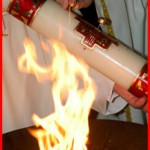 The Easter vigil service is the first Easter service, and takes place on the night of Holy Saturday. The idea behind the service is for faithful Christians to wait and watch, hopeful and confident that Christ will return at midnight. The Easter or Paschal candle is lit during this service. The service traditionally begins outside the church, where minister and faithful gather around a new fire. The service begins with words: May the light of Christ, rising in glory, banish all darkness from our hearts and minds. After being lit outside, the candle is carried into the church, where most of the faithful are waiting in darkness, which symbolises the darkness of Christ’s tomb.
 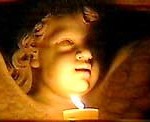 The readings at the service tell of the creation of humanity, how humanity fell from grace, and was repeatedly rescued by God. The readings remind people of God’s promise to be with them always. After more prayers and readings, the candles held by the congregation are lit from the Paschal candle.
Easter Sunday
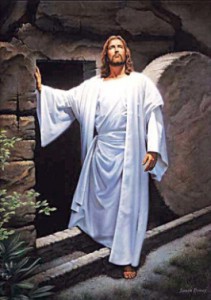 On this greatest day of the year, all fasting and somber thoughts are banished. As St. John Chrysostom announces in this famous Easter sermon, all are invited to the feast: “Let all then enter the joy of Our Lord!…
… O Death, where is your sting?
O Death, where is your victory?
Christ is risen, and the demons are cast down.
Christ is risen, and life is set free.
Christ is risen, and the tomb is emptied of the dead.
For Christ, having risen from the dead, is become the first-fruits for those who sleep.
to Him be glory and power forever and ever!
Amen. Alleluia! Alleluia! Alleluia!”